
Ikigai: a ‘reason for being’
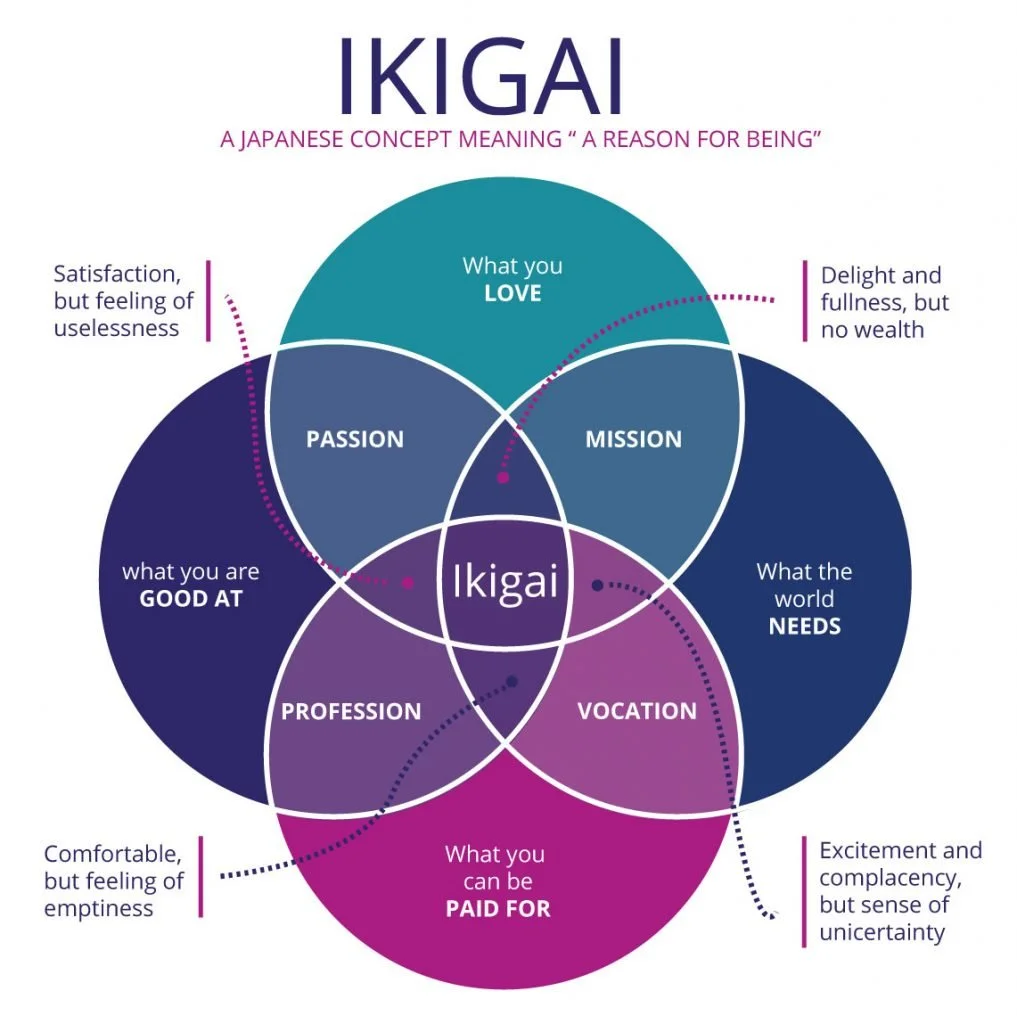
For our exploration of SOURCE this month, here is a concept that aims to bring together some important themes. Below are some questions to help you identify your Ikigai (your purpose, or reason for being) as a way to help contextualise what you want, to align with what motivates and energises you, and to identify ways that you can generate income and fulfil a need in the world.
From Japanese culture, Ikigai is the intersection of what energises us at our source, and what the world needs. It can be understood as a “composite construct, encompassing meaning, motivations and values in life,” say researchers Dean Fido, Yasuhiro Kotera, and Kenichi Asano (2019).
The performance and enjoyment of an activity and our life purpose are all ikigai, arising from a deep awareness of the following (García & Miralles, 2018):
Passion – what you love
Vocation – what you are good at
Mission – what the world needs
Profession – what you can get paid for
According to Yukari Mitsuhashi (2018), ikigai not only concerns our overall life goals and meaning but is found in individual moments and curiosity for every aspect of our way of life.
While challenging to define, its benefits are becoming increasingly evident when combined with positive psychology and preventative medicine. Indeed, research has found ikigai to be a useful predictor of both physical and psychological wellbeing (García & Miralles, 2018; Mori et al., 2017).
Indeed, the positive effects of ikigai are observed in many aspects of life, including (Fido et al., 2019) physical health in the elderly, psychological wellbeing of carers, reduced incidence of strokes and cardiovascular disease, and mental health.
Finding your ikigai
The following questions can be answered to help you identify your ikigai:
Do what you love:
What did you enjoy doing as a child or in your early adult years?
What do you do now in your spare time that makes you happy?Do what you are good at:
Do you know your strengths and skills? What are they?
What do people ask you to help them with?Do something the world needs:
What and who inspires you?
What makes you annoyed or frustrated?Do something you can be paid for:
What service or product could you sell (what would people pay you for)?
What job could you do?
Write the answers down on a piece of paper first, then briefly summarise and transfer them to a blank ikigai diagram. (See below.)
Finding your purpose
Ikigai encourages us to focus on our overall life purpose and the “joy a person finds in living day-to-day” (Mitsuhashi, 2018).
Completing the following sentences may help you become clearer regarding your life purpose and how you can better focus your time and energy:
When I was a child, I loved doing…
If money didn’t matter, I would be…
If I believed I could not fail, I would…
I completely lose track of time when I am…
I am most happy with who I am when I…
I am really good at…
If I didn’t care what others thought of me, I would…
In my free time, I love to…
If I only had six months to live, I would spend my time…
If I were to die tomorrow, I would regret that I did not…
The following people inspire me because they…
Review the completed sentences, adding new ones when you think of them. See the patterns that form and recognise the actions that accompany past activities and future plans.
Then finally, complete one further sentence:
The purpose of my life is to…
Use the completed sentence to help consider and guide your future decisions. If, overall, you shape your life according to the purpose you have found, you will arrive at ikigai.
Source: https://positivepsychology.com/ikigai-test-questionnaires/