
Resilience: facing external challenges as we emerge
Building a resilience prescription for when the going gets tough
Nic Willcocks
It may be an overused word but that doesn’t mean resilience isn’t important.
As a child I naively thought there would be a mythical day, when I became a grown up, that I would arrive at: I would have everything Sorted and Life would be settled and complete. It didn’t take long before I realised that day wouldn’t come - that Life is a constant process of change and evolution, of challenges to navigate and uncertainties to coexist with.
Whether in the context of the wider world around us, or our closer to home worlds and the plans we seek to bring to fruition, our own resilience has an important role to play in how we live through our Odyssey.
Don’t be fooled by the ubiquity of the word in social media, speeches, articles, books and training programmes. Resilience is a foundation for wellbeing, to be actively cultivated. It matters.
Using the language of streaming services like Disney+ Apple TV+, Arianna Huffington wrote an article recently talking about how we all need to develop resilience+ in a world that has endless uncertainty, apocalyptic weather, shifting political social and cultural strands, a pandemic that has become endemic and raging wars new and old. She says that resilience+ is the ‘on demand quality we need’, adding that it is not a marker to reach or a one off action to take, it is a mindset. Resilience, she says ‘is both our vaccine and our booster’. Just as boosters provide us with physical immunity, regular focus on strengthening our resilience is essential to our emotional and mental health as well as our capacity to flourish and thrive.
What is resilience?
The ‘old school’ approach to defining resilience focuses on the idea of toughing things out - pushing on through. So we have the following:
The capacity to recover quickly from difficulties: toughness’ Oxford Dictionary
'The ability to be happy/successful after something difficult or bad has happened' Cambridge
Dictionary
These definitions have validity but are not, in and of themselves, enough and they don’t encapsulate resilience in its variety, uniqueness and fullness. Thankfully, as research into the topic has grown, definitions have become more helpful and thorough. Here are two particular favourites:
‘The capacity to remain flexible in thoughts, feelings and behaviours when faced with life disruption, or extended pressure, so that we emerge from a difficulty stronger, wiser and more able’ Carole Pemberton; Resilience - a practical guide for coaches
Resilience at work is:
‘an individual’s capacity to manage the everyday stress of work and remain healthy, rebound and learn from the unexpected setbacks and prepare for future challenges proactively.’ Katherine McEwan (2016) Building your Resilience: How to thrive in a Challenging Job
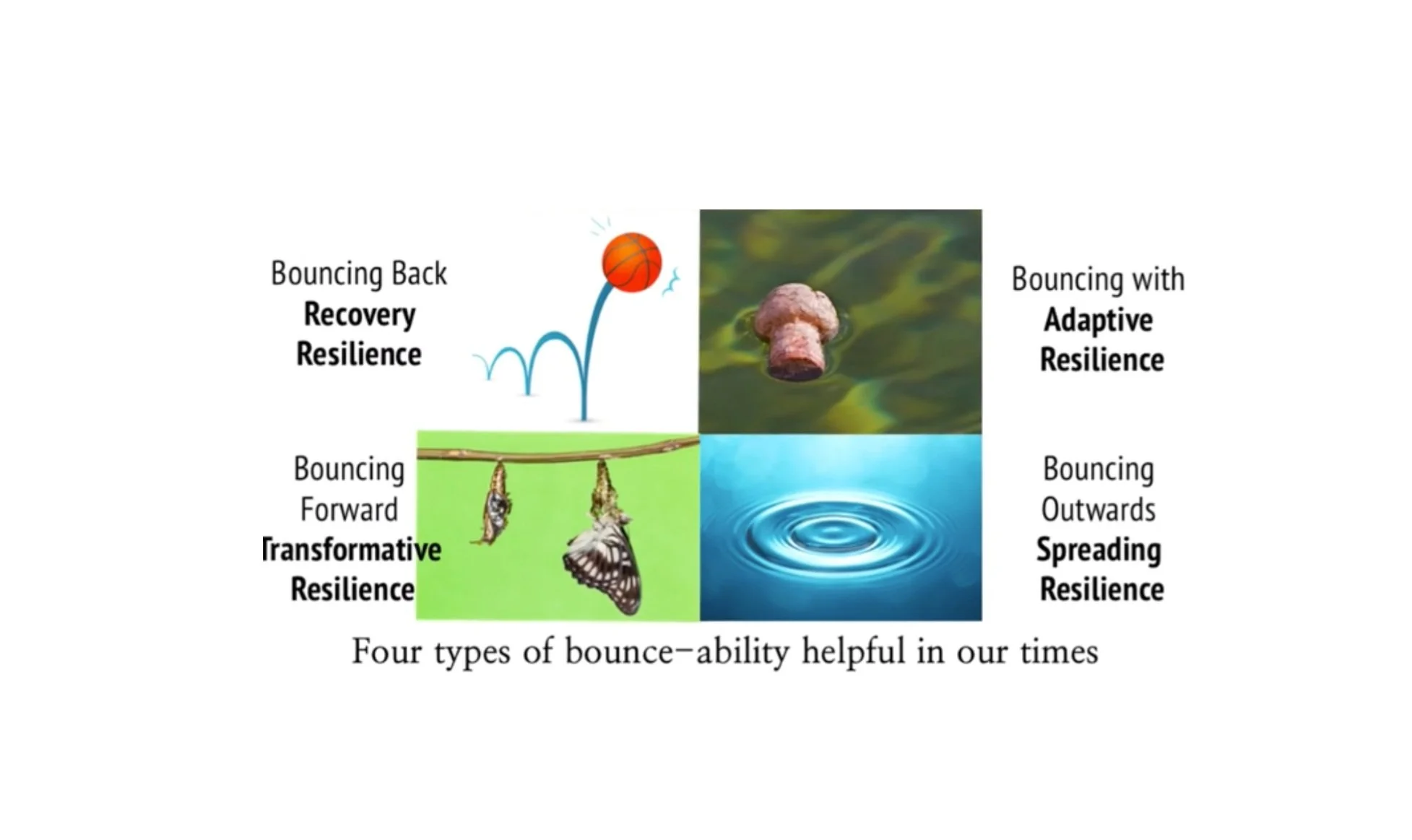
It can be useful to think of resilience as not simply about bouncing back. Chris Johnstone ‘Seven ways to build Resilience’ talks about different forms of ‘bouncing’
Bouncing back - recovery resilience: getting back on our feet
Bouncing with - adaptive resilience - like a cork in the water - bouncing with the waves - adapting and keeping steady amid the changing circumstances
Bouncing Forward - transformative resilience - like a butterfly emerging from a cocoon, we go through adversity and come through it different, learning new skills, different perspectives
Bouncing outwards - spreading resilience - the ripples of our resilience through adversity spread out and may impact others.We can act as a role model and of influence
Sometimes we could be showing one or two types of resilience - sometimes all.
And here is some more food for thought about resilience
Being resilient doesn’t inoculate you against bad things happening
Resilience is subjective, variable and context dependent because we all approach life from different personal experiences, histories, emotions and expectations.
There is no ‘one size fits all’
Resilience is something we all have
Resilience is a life long journey, none of us can claim it as a permanent state
Sometimes our resilience will fail us - but the wider our repertoire of tools and techniques at our disposal the better we can support ourselves. When it does fail us, the most important thing we can do is show ourselves some self compassion
Resilience can be developed and strengthened
Neuroscience has shown that the adult brain is plastic and has the capacity to be rewired to strengthen resilience.
Being able to step back and look at where we are and what has happened and look for the choice points to work towards a better outcome aid our resilience
Sometimes the resilient approach is to say F*** It, I need a duvet day/lie in/bar of chocolate/to say no/ insert your approach of choice.....
So how do we build resilience to equip ourselves for the inevitable ups and downs of Life?
Well, as a starting point, you will be more resilient than you realise. Behaviours or ways of thinking that you take for granted will form part of your unique resilience approach.
There are lots of models of resilience out there - the best ones are evidence based and come from a positive psychology perspective, focusing on building capacity to embrace and learn from life situations.This enables us to grow, develop and be match fit with a healthy mind and body.
The best thing we can do is to work out our own resilience prescription - the unique set of approaches that we can draw on according to what we need in a given situation. And then to conduct regular check ups to ‘amend the prescription’ as we fine tune what is most useful for us.
You may like to reflect on:
What resilience means for you?
When has your resilience been tested?
What helped you?
When you are being resilient and supporting yourself well - what is your thinking style, what kind of things are you doing and how are you feeling?