
10 Ways to Build and Preserve Better Boundaries

As busy parents, we often describe putting certain boundaries in place - often in response to something that might not be working. There is an invisible line, and it has been crossed. A boundary is needed.
We might need boundaries to change the rules or describe what is now acceptable (or not). We might need them to communicate something important to someone else or express what you need in certain terms.
In whatever way they show up - they are often conceptual. They are good ideas, rather than good practices - and when 'breached', can often leave us feeling unable to manage ourselves and the forces exerted upon us.
However, boundaries are an essential way of managing the expectations of others and allow you to make choices about your interactions that fundamentally work for your benefit. The more obvious they are (something that you might see or hear), the more likely they will be noted and respected by others.
They are not designed to be punitive or a way to keep things at arm’s length; instead, boundaries are useful expressions of what is acceptable - and what is not. They help manage our knowledge of ourselves, and the expectations others have of us. They are there to preserve and enrich relationships, rather than limit or stifle them.
Some people struggle to put boundaries in place (and find themselves saying 'yes' and doing everything for everyone, everyday) because they fear negative consequences. There is a deeply set concern about letting someone down, or a fear of rejection if you were to say 'no'. We say 'yes' to avoid the difficulty of saying 'no'.
Those with people pleasing tendencies often find themselves worn out by the expectations of others, often not questioning the logic of needing to please, or being the one to fix and solve the problems of others. But then resentment can set in. It can be exhausting, frustrating and demeaning to be thought of so casually by other people. Look what you do for them!
However, becoming a parent means that your capacity changes dramatically - and while you might have once been able to keep everyone happy all the time; with a family, that feels impossible to sustain. In fact - your families often become the source of need that trumps all else.
What are boundaries?
Boundaries can take many forms. They can range from being rigid and strict to appearing almost nonexistent.
If you have more rigid boundaries, you might:
keep others at a distance
seem detached, even with intimate partners
have few close relationships
avoid close relationships
If you have more loose or open boundaries, you might:
get too involved with others’ problems
find it difficult to say “no” to others’ requests
overshare personal information with others
seek to please others for fear of rejection
A person with healthy boundaries understands that making their expectations clear helps in two ways: it establishes what behaviour you will accept from other people, and it establishes what behaviour other people can expect from you. If you have healthy boundaries, you might:
share personal information appropriately (not too much or not too little)
understand your personal needs and wants and know how to communicate them
value your own opinions
accept when others tell you “no”
Many of us have a mix of boundaries depending on the situation. For example, you might have strict boundaries at work and more loose ones at home or with family and friends.
There might even be different boundaries based on a person’s culture. For example, some cultures find that sharing personal information is not appropriate at any time, while in other cultures, sharing might be encouraged at all times.
Types of boundaries
Building healthy boundaries — whether you’re at work, at home, or hanging out with friends — hinges on understanding the types of boundaries.
There are different types:
Physical/Sexual. This refers to your personal space, your privacy, and your body. You might be someone who is comfortable with public displays of affection (hugs, kisses, and hand-holding), or you might be someone who prefers not to be touched in public. Even comments about your physcial or sexual self may be a boundary crossed.
Intellectual/Mental. These boundaries concern your thoughts and beliefs. Intellectual boundaries are not respected when someone dismisses another person’s ideas and opinions.
Emotional. This refers to a person’s feelings. You might not feel comfortable sharing your feelings about everything with a friend or partner. Instead, you prefer to share gradually over time. You might also want to control how emotionally available you are to others.
Financial/Material. If you like to save money you might not want to loan money to a friend who chooses to do something else with it.It also refers to broader financial decisions.
Conversational. Topics that you do and do not feel comfortable talking about.
Time. How much time you spend, invest or feel you waste with people and acitivities.
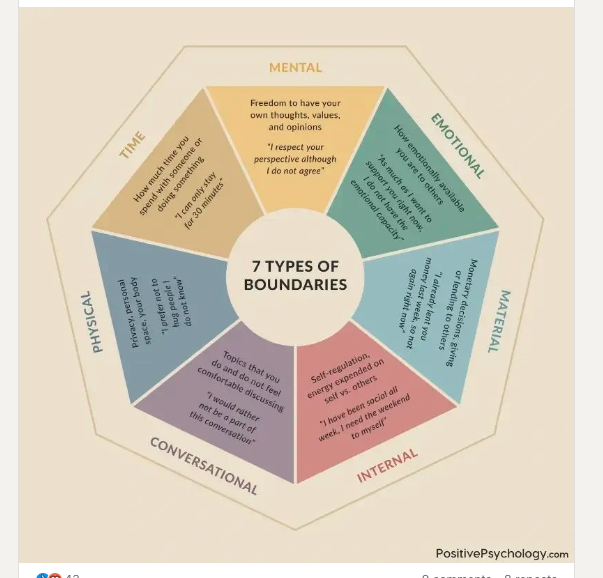
The lowdown on personal boundaries
“In a nutshell, it’s knowing how to separate your feelings or ‘stuff’ from someone else’s,” says U.K.-based psychologist Dr. Tara Quinn-Cirillo. “As human beings we have our own thoughts, memories, and lived experiences, and sometimes that can become very blurred with someone else’s. Boundaries are healthy for helping you identify and keep that space.”
Whereas security alarms signal when physical boundaries are crossed, you have to rely on your own internal alert systems to determine when your emotional and psychological boundaries are infringed upon.
For example, “If you come away from a meeting or telephone conversation with friends, family, or anyone, feeling depleted, anxious, [or] wound-up, there are probably boundaries being breached,” explains Sally Baker, a senior, licensed, and accredited therapist in London, U.K.
Setting boundaries is beneficial for far more than just defining our identity. Having them in place “limits your exposure to stress and the [body’s] production of adrenaline and cortisol [the stress hormone],” Baker says. “It protects your mental well-being.”
Dr. Quinn-Cirillo agrees that well-being is a key factor, as a lack of boundaries can “lead to emotional and physical fatigue,” especially if you have to deal with the exhausting behaviours of others.
And it doesn’t end there. Boundaries promote a sense of autonomy, says Dr. Quinn-Cirillo, in “that you are in control as far as possible in what you want and don’t want.” They can also “keep you safe in relationships at work, home, and with partners, and that’s really important.”
Research also shows that blurred boundaries, particularly between work and home life, are linked to unhealthier lifestyles and lower levels of happiness, along with a higher risk of family conflict. So, you’ll want to get yours in check.
How do you establish a boundary?
Below are some useful questions to help determine what boundaries might need to be in place - and how to go about doing so.
1. What is happening in life that feels out of kilter in some way?
2. What has changed that requires a boundary in place?
3. What would it give you to have a boundary in place?
4. What could the boundary look like in practice - what would I see or hear that demonstrates your boundary?
5. Who needs to know about your boundary and what do you need to communicate to them?
6. What happens when the boundary is breached or crossed? What needs to be communicated now?
Two useful boundaries when all else fails…
The Pause
I recommend a valuable type of boundary for those moments where one might be needed - but you're not sure what. THE PAUSE.
THE PAUSE allows you to decide how to respond. It is a verbal and mental boundary that allows you to think for yourself, and not respond with a knee jerk 'yes'.
THE PAUSE allows you to choose your 'no' - which might include 'no, but what about this instead' or 'that won't be possible for me, but have you thought of X?'
No.
'No', by the way, is a full sentence.
You don't need to justify your decisions half as often as you think you do.
Try it. I wonder what will happen?
Usually, we are resisting to fear of letting someone down, and worried about the consequences if you don't say 'yes'. But, here are some additional pointers....
Trust your instincts. You'll know what is best for you, even if it is not best for someone else.
Know that by demonstrating your boundaries, you are showing respect for yourself - and for someone else's ability to find their own solution. It also shows, and invites them, to manage their own boundaries effectively.
Plan a response to a boundary crossing, practise it, make it come easily. You might need to help others recalibrate what they can expect of you.
10 Ways to maintain good boundaries
Written by Chantelle Pattemore, 2021 (Source: https://psychcentral.com/lib/10-way-to-build-and-preserve-better-boundaries)
Not sure how to go about creating boundaries or effectively uphold existing ones? We’ve rounded up some of the best approaches to try.
Enjoy some self-reflection
To successfully introduce and set boundaries, it’s key to understand why they’re each important to you and how they will benefit your emotional well-being.
“Take some time to be a detective of your own psychology,” suggests Baker. “So often stuff happens to people and they feel uncomfortable, but they’re not sure why. The first step in having healthy boundaries in any situation is spending the time to explore what’s happening to you.”
Start small
If you don’t have many boundaries in place already, the prospect of introducing more might seem overwhelming — so build them up slowly.
Doing so allows you to take things at a more comfortable pace, and it provides time to reflect on whether it’s heading in the right direction or if you need to make some tweaks.
Set them early
“Sometimes it can be really hard to start putting boundaries in, especially in pre-existing relationships,” says Dr. Quinn-Cirillo. “If you can put in boundaries straight away, it’s a lot easier to work with.”
By setting boundaries and expectations from the very beginning, everyone knows where they stand, and feelings of hurt, confusion, and frustration can be lessened.
Be consistent
Letting boundaries slide can lead to confusion and encourage new expectations and demands among those around you.
Try keeping things consistent and steady. This helps to reinforce your original thresholds and beliefs, and it ensures those lines remain clearly established.
Create a framework
Dr. Quinn-Cirillo notes that boundaries “vary depending on the type of relationship.” However, if you find it helpful, there’s no reason not to have a few basics in place that can be adapted accordingly.
Consider getting an hour or two of alone time each weekend. This boundary could apply whether you live with a partner, have a busy social schedule with friends, or are close with your family.
Feel free to add extras
In some aspects of our lives, there are boundaries already in place — such as in the workplace. But consider these the minimum. Colleagues will likely have some of their own in place, and it’s okay for you to add some too.
Doing so may even enhance your performance. Austrian researchers found that employees who introduced personal workplace boundaries felt more empowered.
Be aware of social media
These platforms allow for more communication than ever, but they’ve also encouraged some considerable boundary blurring.
“There’s some incredible oversharing happening,” Baker states, and research shows that over half of us are concerned that family and friends will post personal information or photos that we don’t want shared publicly.
If you deem a particular action as boundary-crossing in real life, your concerns are no less valid when it occurs digitally. “You don’t have to expose yourself to social media that’s distressing you,” she adds.
Talk, talk, talk
Communication is critical in the world of boundaries, especially if someone consistently oversteps yours. While you might need to raise your concerns, these discussions need not be confrontational.
For example, if you have a friend who sends messages nonstop, Dr. Quinn-Cirillo suggests saying something along the lines of, “‘I can see you really wanted to get hold of me, but the best thing to do is drop me a message, and I’ll get back to you when I can.’” This gently highlights their behaviour while simultaneously asserting your threshold.
Be your biggest champion
For boundaries to have a strong foundation, you need to show yourself a bit of love, notes Baker. “If you’ve got a narrative in your head that says you’re worthless and undeserving, then you’re going to find it difficult to put boundaries in place that protect you,” she says. “A lot of it comes down to self-worth and self-value.”
It doesn’t take much to start encouraging this mindset either, adds Baker. The more you engage in activities “that release feel-good hormones, like singing, running, or whatever you want to do — things that feed your own heart — then that’s going to help change your internal dialogue and make you feel more deserving.”
Gain some perspective
Not having boundaries can be detrimental to our mental health, but going too far and over-thinking them can also impact our emotional well-being, reveals Dr. Quinn-Cirillo.
“Get a healthy level of thinking about boundaries,” she says. “Have some but don’t be dictated by them. Sometimes you’ve just got to go with your gut instinct. We can forget that we’re actually quite good at navigating most things and are quite intuitive as human beings.”
Recognising the boundaries of others
In addition to setting your own boundaries, it’s important to appreciate those of others, too — even if they’re different from your own. So how can you determine what they are?
Frustratingly, “there’s no magic science,” says Dr. Quinn-Cirillo. “If you’re concerned or unsure, just ask.” Fortunately, the conversation doesn’t have to be awkward or confrontational. “Just general discussion helps,” she continues. “Say something like, ‘Can I message you later?’ or ‘When is it good to message?’ They help start to put a framework in place.”
It’s also about using your common sense. If your partner hates using social media, there’s a good chance they won’t want those coupled-up selfies plastered across your Instagram or Facebook account. Or, if a friend says they don’t want to see a particular movie, don’t pester them until they cave in.
Dr. Quinn-Cirillo reveals that repeatedly violating boundaries “can breed resentment and contempt, and cause people to withdraw.” So there’s no harm in taking a moment to think before you act.
Let’s recap
Boundaries are essential for various reasons and look different to everyone. You might be concerned that they will make you seem unfriendly or confrontational, but as this Inside Mental Health podcast from Psych Central reveals (also in the resources this month), it is possible to maintain them without upsetting those you care about.
Don’t feel guilty about setting boundaries. They’re essentially a form of self-care, and we actively look to incorporate other elements of this into our lives daily — from eating a balanced diet to exercising. This is no different!
It might take some time and consideration to decipher the boundaries most important to you and the best ways to implement them, but your mental well-being will appreciate the effort in the long run.